
AI in supply chain management for smarter, faster decision-making
Our annual Business Trends Report confirmed that logistics and supply chain organisations have a real need to move from pilot projects to full-scale digital orchestration in 2026.
by Adrian West VP of Retail, Wholesale, Logistics & Manufacturing
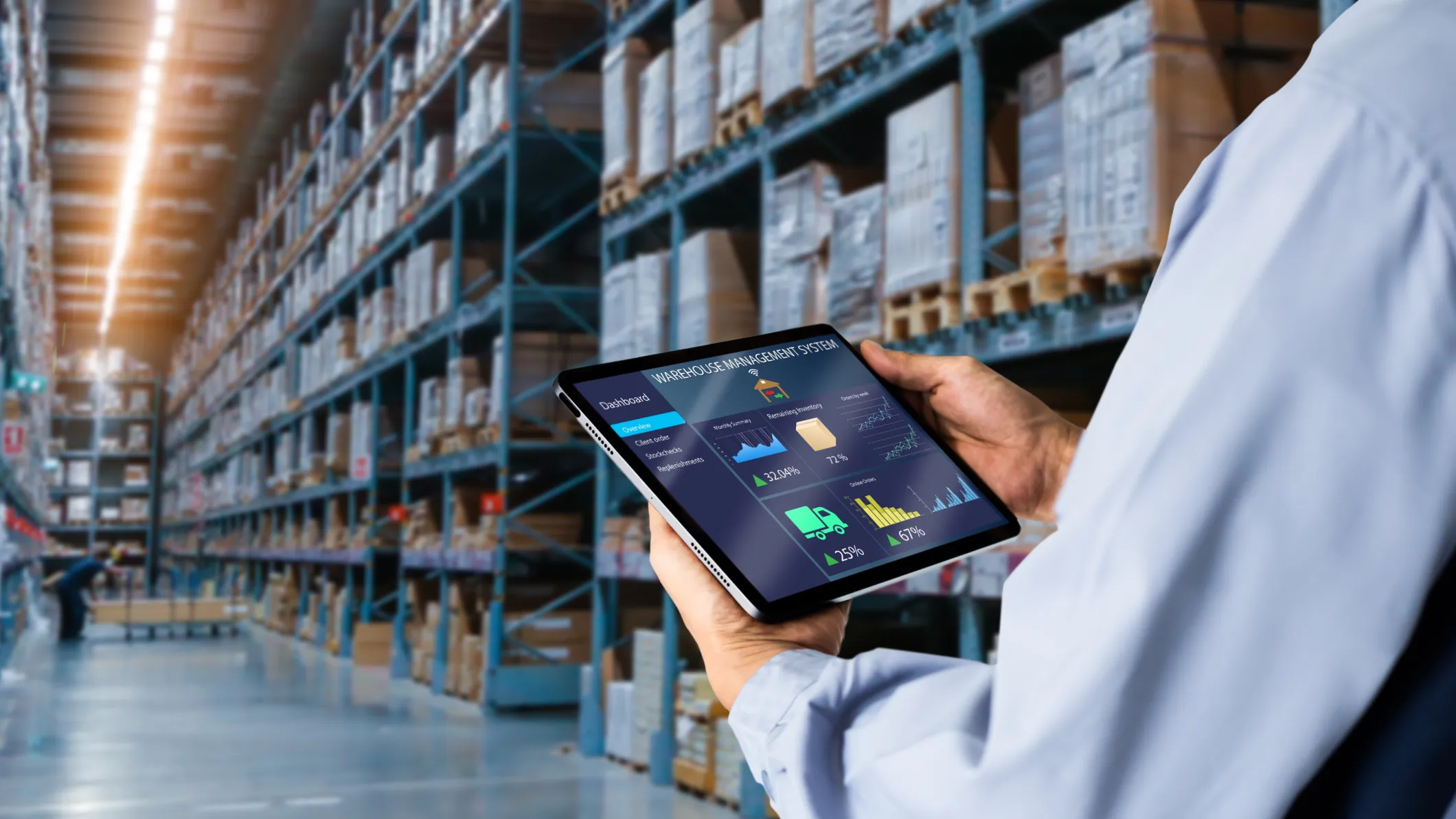
The industry is at a critical juncture. With 53% of logistics and wholesale participants prioritising AI adoption and integration over the next 12 months, these sectors are moving rapidly to navigate a perfect storm of economic volatility and tight margins.
For those looking to move beyond surface-level tech hype, the defining challenge of the year is understanding how to successfully embed AI into supply chain management processes, transitioning your business from isolated functions to a resilient, predictive ecosystem.
What AI in supply chain management actually means today
In practical, business-ready terms, AI in the supply chain is the application of advanced computing to solve complex logistical problems that are too dynamic for traditional software. It isn't just a "set and forget" tool; it is a system that learns from historical data and real-time signals to provide actionable insights or automated actions.
Traditional automation is rules-based; it follows a strict "if this, then that" logic. While effective for simple repetitive tasks, it breaks down when faced with the unpredictability of a large network. Modern AI differs because it is probabilistic; it can handle ambiguity, recognise patterns in chaotic data sets, and adapt its rules as new information (like a sudden port strike or weather event) comes to light.
Core technologies powering AI in supply chain management
- Machine Learning (ML): Enables systems to improve forecast accuracy over time by identifying hidden patterns in demand.
- Predictive Analytics: Uses historical data to anticipate future outcomes, such as identifying which shipments are most likely to be delayed.
- Natural Language Processing (NLP): Extracts valuable data from unstructured sources like emails, contracts, and shipping manifests.
- Computer Vision: Powers automated quality checks in warehouses and monitors cargo health through visual sensors.
- Generative AI: Summarises complex supplier risks and creates "what-if" scenarios for supply chain planning in plain English.
How AI integrates across end-to-end supply chain workflows
The power of AI can only be fully realised if there is connective tissue across the business in terms of systems. Rather than operating in siloes, where manufacturing doesn't know what logistics is doing, the dots should be connected beforehand, and the data should be cleaned so that the input into AI is of the highest quality. A delay in sourcing raw materials should automatically update production planning and adjust distribution schedules, creating a unified flow of information across the entire value chain.
The strategic role of AI in supply chain management
AI has evolved from a back-office experiment to a strategic operational intelligence layer. It provides the speed and accuracy necessary to manage the just-in-time realities of 2026.
From reactive operations to predictive and autonomous systems
Historically, supply chain management has been reactive: a problem occurs, and humans scramble to fix it. We are now seeing a shift toward autonomous systems that can independently evaluate alternate routes or re-allocate inventory based on scenario-modelling, moving closer to a self-healing supply chain.
Improving visibility, coordination, and accountability at scale
With 10% of our survey participants citing poor integration as their biggest challenge, it is clear that interconnected visibility is needed to track performance across complex networks. When organisational systems are bridged, AI can help with bringing previously hidden insights to light. This transparency then ensures every supplier and logistics partner is held accountable to real-time KPIs, reducing the "somewhat aligned" trap that 62% of organisations currently face.
High-impact use cases of AI in supply chain management
Demand forecasting and inventory optimisation
AI can reduce the bullwhip effect by analysing far more than just past sales. By factoring in local events, social trends, and economic shifts, it improves forecast accuracy, significantly reducing the safety stock bloat that ties up working capital.
Production planning and capacity optimisation
AI-driven scheduling manages complex constraints, like machine downtime, labour shifts, and energy costs, to ensure manufacturing lines run at peak efficiency without manual intervention.
Supplier risk management and sourcing intelligence
Beyond cost, AI can evaluate supplier health by scanning news, financial reports, and ESG filings. It helps leaders identify alternate sourcing options before a primary supplier fails, protecting continuity.
Logistics, network design, and route optimisation
AI is used to evaluate millions of variables; traffic, fuel prices, and delivery windows, to optimise last-mile delivery. It ensures freight is moved at the best possible price, addressing the thin margins that currently define the sector.
Predictive maintenance and asset performance
By analysing sensor data from trucks and warehouse machinery, AI predicts mechanical failures before they happen. This reduces unplanned downtime and extends the lifecycle of expensive logistics assets.
Measurable benefits of AI in supply chain management
- Cost reduction and margin protection: AI identifies margin leakage by spotting waste in excess inventory and inefficient transport routes.
- Faster, higher-quality decisions: Scenario modelling gives leadership the confidence to make pivots in minutes, backed by real-time data rather than “gut feel”.
- Improved resilience: When disruptions occur, AI-ready businesses have a significantly lower Time to Recovery (TTR).
- Sustainability outcomes: Optimised routing reduces carbon emissions, while better demand planning minimises physical waste, supporting ethical and green supply chain goals.
Challenges and risks of AI in supply chain management
While the ambition is high, the road to maturity has a few speedbumps:
Data quality, availability, and integration complexity
As we’ve touched upon, AI is only as good as the data it consumes. Many operators struggle with fragmented infrastructure where data is stuck in legacy spreadsheets. Success requires a foundation of clean, connected data.
Model trust, explainability, and governance
With 49% of leaders maintaining that human oversight is important, there is a clear need for "Explainable AI”. Stakeholders must understand why a system recommended a specific supplier to maintain accountability.
Change management and skills readiness
The skills gap is the single biggest barrier for 11% of leaders. Scaling AI requires a workforce that is trained to work alongside technology, viewing it as a partner that empowers their role.
How AI in supply chain management works in practice
The operating model for AI is a continuous loop of data and action:
- Data ingestion: The system pulls signals from internal ERPs and external sources like weather feeds or traffic.
- Model training & simulation: AI runs thousands of simulations to find the optimal path forward, learning from the outcomes of previous decisions.
- Decision execution: High-confidence tasks are automated, while complex exceptions are flagged for human-in-the-loop control, ensuring human judgment remains at the helm for critical pivots.
Preparing an organisation for AI in supply chain management
- Assessing maturity: Be realistic about your data foundations. You cannot run advanced AI on broken data.
- Defining high-value use cases: Don't try to boil the ocean. Prioritise use cases with the highest ROI, such as demand forecasting or route optimisation.
- Selecting platforms: Decide whether to build custom models or buy integrated, cloud-native platforms that offer infused AI capabilities.
- Scaling pilots: Move beyond experimentation by standardising tech adoption across all regions and warehouses.
Learning resources and credentials in AI in supply chain management
AI in supply chain management courses and certifications
Professional bodies and universities now offer executive education and certifications focusing on AI application in logistics. These programmes are vital for bridging the skills gap and building internal capability.
Books, research papers, and academic insights
For deeper learning, systematic reviews and research papers on "Autonomous Supply Chain Orchestration" provide a look at the theoretical future of the industry, while various business-led books offer practical implementation guides.
Practical resources such as case studies, PDFs, and presentations
Many organisations rely on industry-specific PDFs, implementation slide decks, and case studies to benchmark their progress against peers and present business cases to the board.
FAQs
How does AI improve supply chain forecasting accuracy?
AI identifies non-linear patterns and external signals that traditional models miss. It uses continuous learning loops to refine its predictions as market conditions change.
What industries benefit most from AI in supply chain management?
Retail, wholesale, logistics, manufacturing, healthcare, and energy sectors benefit most due to their high volume of data, complex networks, and the high cost of operational delays.
Is AI in supply chain management difficult to implement?
It can be complicated due to legacy system integration. However, by focusing on modular, cloud-native tools and addressing data quality first, organisations can see ROI faster.
How does AI support sustainable supply chain practices?
AI directly reduces the environmental footprint by optimising routes to save fuel, reducing waste through better inventory management, and ensuring suppliers meet ethical sourcing standards.
Assessing your AI readiness
Is your organisation keeping pace with the 53% prioritising AI, or are you among the 62% feeling the alignment gap? Our 2026 Wholesale & Logistics Trends Report dives deeper into the specific AI use cases delivering the highest ROI right now in these industries.
Download your copy to gain insights for the year ahead and benchmark yourself against peers.
About the author
Adrian West
VP of Retail, Wholesale, Logistics & Manufacturing
Adrian has more than 20 years of experience with digital transformation, consultative selling, developing and executing compelling strategies, and passionately leading high-performing teams. He is a proven customer-centric leader, delivering outstanding business outcomes. As the Vice President of Retail, Wholesale, Logistics, and Manufacturing at OneAdvanced, Adrian is tasked with driving growth by helping our customers in these sectors to grasp the full benefits of technology.
Contact our sales and support teams. We're here to help.
Speak to our expert consultants for personalised advice and recommendations or to book a demo.
Call us on
0330 343 4000Please enter your details, and our team will contact you shortly.
All fields are required
From simple case logging through to live chat, find the solution you need, faster.
Support centre