
Agentic AI vs AI agents: Understanding the differences to drive better business outcomes
The key difference between agentic AI and AI agents lies in their level of autonomy: Agentic AI decides what to do next, while AI agents execute what they’re told.
by OneAdvanced PR Press Team
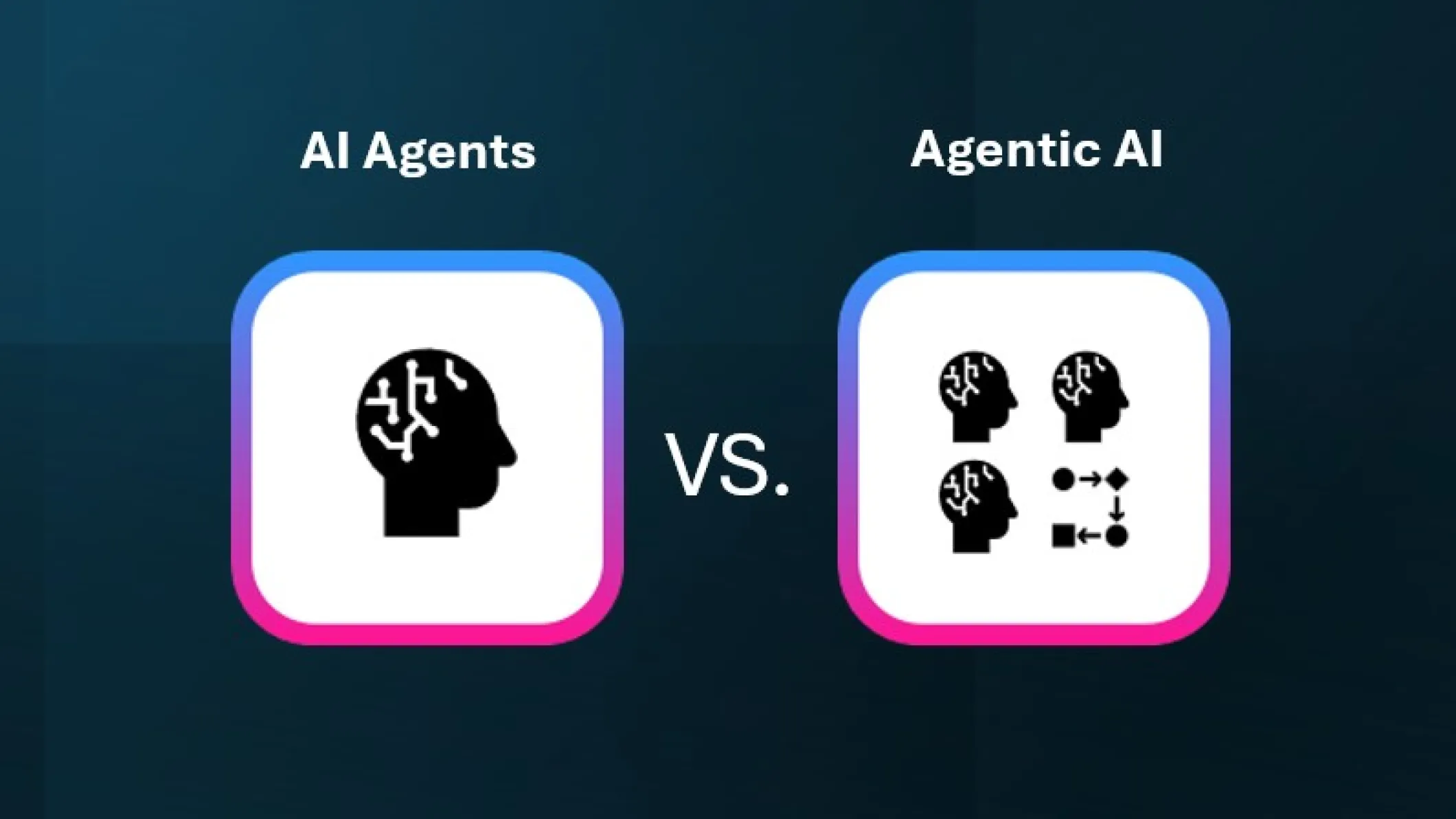
Many UK leaders use "agentic AI" and "AI agents" interchangeably, but both are built differently and suited to different jobs. Choosing the wrong approach, or assuming the two are interchangeable during procurement, can mean overspending on orchestration you don't need, or under-investing in the governance a genuinely autonomous system demands.
What is the difference between agentic AI and AI agents?
Agentic AI are intelligent systems that can reason, plan, and act autonomously across multiple steps to reach a goal with minimal human input. AI agents, on the other hand, are task-specific tools that follow predefined rules to complete one job when triggered. The key difference lies in their level of autonomy: agentic AI decides what to do next, while AI agents execute what they’re told.
Key differences at a glance
|
Dimension |
AI agents |
Agentic AI |
|
Scope |
Single, well-defined task |
Multi-step goals across systems |
|
Decision-making |
Follows predefined rules and logic |
Follows predefined rules and logic |
|
Trigger |
Reactive – waits for a prompt or signal |
Proactive – monitors and initiates action |
|
Learning |
Static; needs retraining to improve |
Continuous, feedback-driven improvement |
|
Human oversight |
Depends on humans to handle exceptions |
Uses human oversight as a safety layer |
|
Build complexity |
Lower, needs APIs and workflow tools |
Higher, needs reasoning engines, memory, orchestration |
|
See AI agents in action OneAdvanced's AI Agent Marketplace, built on OneAdvanced IQ platform, brings together sector-specific AI agent capabilities for healthcare, legal, education, finance and the public sector. |
Key differences between agentic AI and AI agents
Autonomy and decision-making
- AI agents: Execute predefined tasks within a defined scope, following specific rules or instructions.
- Agentic AI: Interprets goals, plans the steps needed to achieve them, adapts to changing conditions and coordinates multiple agents or systems autonomously.
Enterprise example: A OneAdvanced Shift Assignment Agent matches employee availability, skills and compliance requirements to fill shifts efficiently. An agentic AI logistics system takes a broader role by detecting shipment delays, assessing their impact across the supply chain and automatically coordinating alternative routes to minimise disruption.
Proactive vs reactive behaviour
- AI Agents: Reactive in nature, wait for triggers such as user prompts or system signals.
- Agentic AI: Proactive by design, continuously monitors its environment, anticipates emerging needs, and adjusts its actions before a problem becomes visible.
Enterprise example: A customer support AI agent responds only after a query lands. A marketing-focused agentic system detects declining engagement, tests new creative, and retargets audiences before performance visibly dips.
Learning capabilities and adaptability
- AI Agents: Rely on static, rule-based structures that need explicit retraining to expand what they can do.
- Agentic AI: Learns continuously through reinforcement learning, feedback loops and context modelling — adapting to new scenarios 40–50% faster than rule-based agents, according to Stanford HAI's AI Index Report.
Enterprise example: An AI agent processing expense claims must be manually updated when company policies or approval thresholds change. An agentic AI system can interpret the new policy, adapt its decisions automatically and apply the updated rules with minimal human intervention.
Human oversight and reliance
- AI Agents: Depend directly on humans – their deterministic nature means someone has to step in whenever an exception falls outside the rulebook.
- Agentic AI: Uses human oversight as a safety layer, monitoring, evaluating and correcting its own reasoning rather than being blocked by it.
Enterprise example: An AI agent automatically approves standard leave requests based on company policy and escalates exceptions to a manager. An agentic AI system goes further by assessing staffing levels, business priorities and compliance requirements to recommend the best course of action for final approval.
Complexity and cost to build
- Agents: Simpler and cheaper to build, typically using workflow automation tools or APIs within structured, rule-bound environments.
- Agentic AI: Requires reasoning engines, planning modules, memory components and feedback mechanisms, integrated with large language models (LLMs) and contextual databases.
Enterprise example: A customer service AI agent triages and routes support tickets using predefined workflows. and APIs. By contrast, an agentic AI support system is far more complex and costly to build because it must understand customer intent, retrieves relevant information and coordinates actions across CRM, knowledge and billing systems to resolve issues autonomously.
Architecture and frameworks: How they're built
Agentic AI vs AI agents: both rely on artificial intelligence, but the architecture and frameworks differ significantly. Agentic AI is typically built as a multi-agent system, where specialised agents collaborate under an orchestration layer, while AI agents usually run as single, standalone processes.
|
Aspect |
Agentic AI |
AI Agent |
|
Architecture type |
Designed with architecture that emphasises reasoning, planning, and autonomous execution across multiple systems. |
Built on rule-based structures that respond to explicit inputs, commands, or signals. |
|
How they work |
Operate as an interconnected, intelligent team of agents capable of collaboration, adaptive planning, and response to evolving objectives or contexts. |
Function within narrow, well-defined domains, handling specific responsibilities such as scheduling, responding to user queries, or generating insights. |
|
Frameworks used |
Multi-agent frameworks like LangGraph, AutoGen, or OpenDevin, supported by orchestration layers for communication, learning, and contextual management. |
Lightweight frameworks or API-based automation platforms like RPS tools, workflow systems, Microsoft Copilot Studio, or OneAdvanced IQ |
|
Decision-making |
Rely on contextual reasoning to evaluate options and determine the best next action autonomously. |
Governed by predefined logic flows and conditional rules (for example, “if X occurs, execute Y”). |
|
Integration style |
Designed for deep coordination across multiple tools, databases, and AI models simultaneously. |
Connects with a limited number of systems or APIs within a single process chain. |
Popular agentic AI frameworks
- LangGraph: Enables agentic reasoning with persistent memory, planning capabilities, and seamless inter-agent communication.
- OpenAI Agents: Provide an open infrastructure for orchestrating multi-agent systems that can pursue complex, goal-driven missions, from research to enterprise automation.
- AutoGen: A framework for coordinating conversational, multi-agent workflows.
- LLM-native agents: Built on large language modelslike GPT or Claude, demonstrate early forms of natural language reasoning and planning.
Popular AI agent platforms
- Automation platformssuch as UiPath, Blue Prism, and Automation Anywhere - essential for streamlining workflows and rule-driven operations.
- Domain-specific agentsinclude chatbots, IT helpdesk assistants, and HR automation tools, which deliver reliable, scalable task execution within defined business functions.
- Enterprise-grade platforms like OneAdvanced IQ which bring together sector-specific AI agents, agentic AI capabilities, oversight and compliance within one connected, trusted, intelligent system of work.
Agentic AI vs AI agents: Use cases
Although both agents and agentic AI power the world of work, their roles differ based on design and capability.
Use cases for AI agents
AI agents excel in task-specific, repeatable processes where speed, accuracy and consistency within set parameters matter most: Here are some common applications:
- Customer service automation: Rule-driven chatbots manage FAQs, track orders and route tickets, escalating only when a case exceeds predefined boundaries.
- Document summarisation: Agents like OneAdvanced's Clinical Summarisation Agent distil key details from patient records, reducing admin workload while supporting more accurate care.
- Workforce scheduling: The Shift Assignment Agent allocates shifts based on fixed criteria such as availability, skills and compliance requirements.
- Process automation: RPA bots handle back-office tasks such as invoice processing or form-filling under strict templates.
Use cases for agentic AI
Agentic AI operates in dynamic, complex scenarios where strategy, autonomy and adaptability are essential. Here are some real-world examples:
- Autonomous ticket triage: In healthcare, agentic AI assesses incoming cases, determines urgency, allocates resources in real time, and adjusts workflows to protect patient outcomes.
- Intelligent research assistants: Tools that autonomously explore market trends, break down complex goals, gather data and assemble actionable strategies without direct supervision.
- Supply chain optimisation: Systems that monitor for disruption, re-route shipments, renegotiate supplier terms and minimise cost while protecting delivery reliability.
|
Not sure which approach fits your workflow? OneAdvanced's sector specialists can help you map the right mix of task-specific AI agents and agentic AI to your compliance, budget and timeline. |
Agentic AI adoption in the UK: What the data shows
Although agentic AI is gaining momentum in the UK, adoption remains at an early stage. While 54% of UK organisations now use AI, up from 35% in 2025, only 7% of AI adopters have implemented agentic AI. By comparison, 85% use more established AI capabilities such as natural language processing and text generation. This suggests that while AI has become mainstream, autonomous AI systems are still emerging.
The biggest challenge isn't ambition; it's execution. Businesses are more likely to face significant barriers when implementing agentic AI (32%) than any other AI technology. Organisations already run an average of 13 AI agents, a figure expected to double within two years, yet 51% of those agents still operate in isolation. Unsurprisingly, 94% of UK IT leaders say the success of AI agents depends on seamless data integration across enterprise systems.
OneAdvanced's Annual Trends Report 2026 reinforces this picture. Although AI adoption and integration is the UK's top business priority, talent development ranks last for investment, creating a growing skills gap. At the same time, 58% of organisations report a platform integration crisis, 55% remain stuck in "automation purgatory", and only 39% have automated and integrated most of their business processes. Together, these findings show that the greatest barrier to scaling agentic AI is not the technology itself, but the people, platforms and governance needed to support it, precisely the fragmentation OneAdvanced IQ is built to remove by connecting data, workflows and AI into a single system of work.
Which should you choose? A decision guide
The question isn't agentic AI vs. AI agents: which one is better? It's when and how to use each to maximise return on intelligence.
|
Business need |
Choose AI Agents When… |
Choose Agentic AI When… |
|
Task complexity |
Targeted, rule-based tasks: answering queries, scheduling, drafting summaries |
Interconnected workflows: customer support, financial cycles, cloud migrations |
|
Resource commitment |
You want a quick productivity win with minimal investment |
You can commit to setup, governance and oversight for compounding returns |
|
Workflow scale |
Large volumes of repetitive, structured processes |
Complex systems with evolving, interdependent variables |
|
Implementation timeline |
Rapid launch using existing APIs and automation tools |
Design, orchestration and continuous refinement over time |
|
Governance |
Human oversight ensures compliance and predictability |
Systems monitor, reason and self-correct under ethical supervision |
Is your organisation ready for agentic AI?
Before implementing agentic AI, ask yourself the following questions to determine whether your organisation has the people, technology and governance needed to adopt and scale agentic AI successfully.
- Have you already automated repetitive, rule-based tasks with AI agents and established clean, reliable data?
- Do you have a named AI governance owner and human-in-the-loop oversight for autonomous decisions?
- Are your business systems sufficiently integrated to enable agentic AI to work across them, rather than creating another silo?
- Can you define a clear, measurable business outcome that justifies the investment in agentic AI, beyond simply pursuing innovation?
Common mistakes when choosing between AI agents vs. agentic AI
- Treating them as interchangeable in procurement. Buying "agentic AI" when what you actually need is a handful of reliable task agents leads to over-engineered, over-priced projects.
- Jumping to agentic AI before foundational automation is in place. Gartner predicts that over 40% of agentic AI projects will be cancelled by the end of 2027 due to escalating costs, unclear business value or inadequate risk controls, with most are early-stage experiments driven by hype rather than a defined use case.
- Underestimating governance and human oversight requirements. Even among UK organisations already deploying agents at scale, roughly half report their agents operating in disconnected silos rather than under unified governance.
- Choosing based on market hype rather than business fit. The right starting point is the use case with clean data, a clear success metric, and tolerance for early iteration — not the flashiest demo.
How OneAdvanced bridges both worlds
At OneAdvanced, we believe organisations don't need to choose between AI agents and agentic AI—they need a platform that brings both together. Built on OneAdvanced IQ, our connected, trusted and intelligent system of work, our AI solutions combine people, data and AI to automate work, support better decisions and deliver measurable business outcomes.
Within IQ, AI agents, sit inside Intelligent Experience, which automate tasks directly within everyday workflows, while agentic orchestration runs through the Intelligent Platform's Data & AI layer enables agentic orchestration across systems. Combined with sector-specific AI agents, seamless integration and built-in governance, organisations can scale AI confidently without compromising security, compliance or human oversight.
Whether you're taking your first steps with AI agents or progressing towards autonomous, cross-functional workflows, the OneAdvanced AI Agent Marketplace provides a practical path to adoption, helping organisations in healthcare, legal, education, finance and the public sector scale AI at their own pace.
|
Ready to move from experimentation to outcomes? Discover sector-specific AI agents and agentic AI capabilities built for UK healthcare, legal, education and public sector organisations. |
Frequently Asked Questions (FAQs)
Is agentic AI better than AI agents?
Neither is inherently "better". They solve different problems. AI agents deliver fast, low-cost wins on repetitive tasks; agentic AI unlocks strategic, cross-system automation but requires more investment, data and governance.
What is an example of agentic AI in business?
A supply chain system that detects a shipment delay, analyses live data, and automatically re-routes deliveries without waiting for a human prompt is a classic example of agentic AI in action.
Can AI agents and agentic AI work together?
Yes. Many multi-agent systems combine task-specific AI agents (handling discrete jobs like scheduling or document summarisation) under the coordination of an agentic layer that plans and sequences the overall workflow.
How do I know if my business needs AI agents or agentic AI?
Start with the task. If it's repetitive, rule-based and well-defined, an AI agent will deliver value quickly. If you're managing an interconnected, evolving workflow, such as end-to-end customer support or financial operations, agentic AI is the better fit, provided you have the governance and data maturity to support it.
What are multi-agent systems and how do they relate to agentic AI?
Multi-agent systems are a core building block of agentic AI: multiple specialised agents collaborate, share context and divide work under an orchestration layer to achieve a shared goal more effectively than any single agent could alone.
What is the difference between agentic AI and generative AI?
Generative AI creates content, such as text, images, code, in response to a prompt. Agentic AI goes further: it uses generative and other AI capabilities as tools within a broader loop of reasoning, planning and autonomous action to achieve a goal, often without a new prompt at every step.
What does "human in the loop" mean in agentic AI systems?
It means a person reviews, approves or can override the AI's decisions at defined checkpoints, rather than letting the system act entirely unsupervised. It's a key safeguard for agentic AI in regulated, high-stakes environments.
How does OneAdvanced's AI Agent Marketplace differ from generic AI agent platforms?
It's built specifically for the sectors OneAdvanced serves – healthcare, legal, education, finance and government – with pre-built, compliance-aware agents such as Shift Assignment Agent and Clinical Summarisation Agent, rather than generic, horizontal automation tools that need heavy configuration to fit regulated UK workflows.
About the author
OneAdvanced PR
Press Team
Our dedicated press team is committed to delivering thought leadership, insightful market analysis, and timely updates to keep you informed. We uncover trends, share expert perspectives, and provide in-depth commentary on the latest developments for the sectors that we serve. Whether it’s breaking news, comprehensive reports, or forward-thinking strategies, our goal is to provide valuable insights that inform, inspire, and help you stay ahead in a rapidly evolving landscape.
Contact our sales and support teams. We're here to help.
Speak to our expert consultants for personalised advice and recommendations or to book a demo.
Call us on
0330 343 4000Please enter your details, and our team will contact you shortly.
All fields are required
From simple case logging through to live chat, find the solution you need, faster.
Support centre