
What are AI agents and how do they improve productivity at work?
Discover how AI agents are revolutionising workflows, enhancing productivity, and enabling faster decision-making
by Astrid Bowser Principle Product Manager
Originally published on 5 December 2025 — Updated 30 April 2026
If your teams are still manually sorting clinical documents, cross-referencing spreadsheets, or re-keying data between systems, this guide is for you.
AI agents are intelligent, autonomous systems that work alongside humans to automate workflows, making tasks faster and simpler. According to Capgemini, AI agents are expected to contribute $450 billion in economic value by 2028. However, trust remains a major obstacle, dropped from 43% to 27% in a year, holding organisations back from investing in AI tools. It’s for this reason that building a solid understanding of what they are and how they work is crucial.
Read on to explore how modern AI agents work, some common types of AI agents, and how you can benefit from them.
What are AI agents?
AI agents are software systems that uses artificial intelligence to complete tasks and achieve goals on behalf of users, without needing step-by-step instructions. If you’ve interacted with a customer support bot or used GenAI to write code in the past, chances are, you’ve already seen early examples of them.
Modern AI agents go further. Powered by Large Language Models (LLMs) or sector-specific Small Language Model (SLM), they can decide what to do next, interact with tools and systems, and carry out complex workflows end-to-end – all within defines scope and set of permissions.
How do AI agents work?
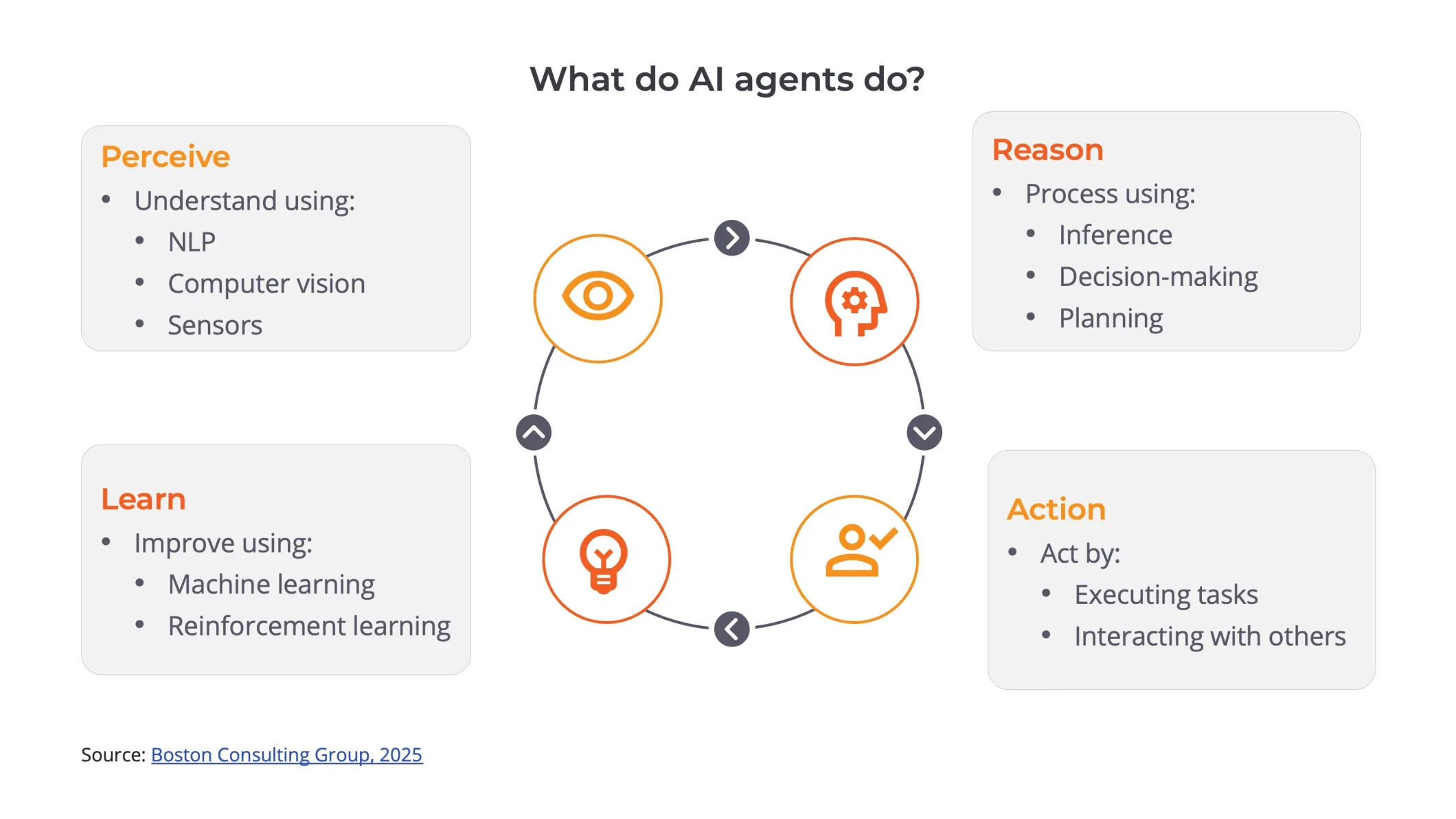
AI agent operates through a continuous loop: Perceive → Reason → Act →Learn. Understanding this cycle, and where human oversight belongs within it, is key to using them effectively and responsibly.
In the following sections you'll explore how this looks like in action:
1. Perceive: Understanding the environment
AI agents begin by gathering inputs from their environment using Natural Language Processing (NLP) for text and speech, computer vision for images and documents, APIs for structured data feeds, and sensors or system events for real-time insights.
Where HITL applies: Humans, at this stage, can confirm that the agent has correctly understood and extracted the relevant data before it moves forward.
2. Reason: Making sense of inputs
Once data is collected, the agent interprets context, identifies the relevant task, and determines what actions are needed to achieve the goal. Memory, both short-term context and long-term vector storage, plays a critical role here, enabling agents to factor in historical decisions and workflow state.
Where HITL applies: Humans may be looped in to validate recommendations before action is taken, particularly in case of goal-based or learning agent architectures.
3. Action: Executing the workflow
Here, the agent is ready to execute its plan – weather that’s filling a document, generating a report, allocating a shift, triggering an alert, or updating a record. More complex setups may involve multiple agents working together to complete tasks in parallel.
Where HITL applies: Humans may supervise, approve, or manually trigger some high-stakes actions.
4. Learn: Improving over time
After completing task, agents improve by learning from outcomes and feedback. They use Reinforcement Learning from Human Feedback (RLHF), fine-tuning cycles, and retrieval index refreshes in this stage. Over time, this helps them become more accurate, efficient, and aligned with organisational needs.
Where HITL applies: Humans, at this stage, act as trainers, and feedback providers, ensuring outputs improve without introducing bias or drift.
The role of LLMs, tools, memory, and MCP
At the core of every modern AI agent is large language models – the engine that interprets context, breaks down goals, and decides the right action. But LLMs alone aren’t enough. For successful outcomes, it requires a set of supporting capabilities:
- Memory: Short-term memory handles immediate context, while long-term memory, managed through Retrieval Augmented Generation (RAG) and vector stores, allows agent to recall past interactions and relevant organisational data, ensuring more informed and consistent outputs.
- Tool calling: Agents use function calling to interact with external APIs, databases, and enterprise systems to retrieve information, update records, and complete tasks in real time.
- Model Context Protocol (MCP): This provides a secure, structured way for agents to access data and systems, with clear permission controls. It ensures agents operate within defined boundaries, especially important in regulated environments.
- Orchestration: For complex tasks, multiple agents can work together. An orchestrator coordinates their actions, manages handoffs, and ensures everything runs smoothly from start to finish. Learn more in our guide to unlocking the power of multi-agent systems.
AI agent vs chatbot vs copilot: What's the difference?
Although AI terminologies can get confusing, the differences between chatbots, copilots, and AI agents matters, especially when deciding how to apply them in real-world operations. If you want a deeper look, our guide on agentic AI vs AI agents explains how the terminology maps to real architectural differences.
Here’s a breakdown.
|
Aspects |
Chatbot |
Copilot |
AI agent |
|
Autonomy |
Reactive in nature. Responds to prompts at every step |
Assistive in nature. Supports user actions |
Proactive in nature. Acts independently towards goals |
|
Task scope |
Simple Q&A or commands |
One task at a time with user guidance |
Multi-step, cross system workflows end-to-end |
|
Memory |
No persistent memory |
Short-term memory with session |
Short-term + long-term through RAG and vector stores |
|
Learning |
None |
Limited |
Continuous via RLHF and fine-tuning cycles |
|
Best application |
FAQ answering, simple queries |
Writing assistance, search, summarisation |
Complex workflows automation, decision support |
Types of AI agents
AI agents can be categorised in many ways based on their behaviour, capabilities, roles, and environments. Classifying agents by type helps us understand which agents could be most suitable for our needs.
For a deeper look at each, visit our dedicated guide on types of AI agents..
1. Simple reflex agents
Agents that act solely based on current inputs, without considering past or future consequences. They respond to specific conditions using pre-defined rules.
Key characteristics include:
- Operates on ‘if-then’ logic only without any reasoning
- Responds instantly to a single input without planning or sequencing
- No memory and each interaction is treated as entirely new
- Best deployed in fully observable environments where every relevant variable is visible
Limitations:
- Can’t handle unfamiliar or partially observable situations outside predefined rules
- No adaptability – rules must be manually updated as needs change
- Difficult to maintain and audit due to growing rule complexity
|
Real world example: If an employee clocks in late three times in a month, the system automatically sends an alert to the manager. |
2. Model-based agents
Agents that maintain an internal model of their environment (for example, your workflow) but understand past states (memory) and inform their current decisions.
Key characteristics include:
- Use historical data, not just immediate inputs, to produce output
- Handle incomplete information by drawing insights on past patterns
- Well- suited for workflows with sequential dependencies or time-based logic
- Amore adaptable than reflex agents when conditions change
Limitations:
- Still follow predefined rules rather than independent reasoning
- Don’t plan toward long-term goals – they respond rather than strategise
- Performance declines if their internal view of the environment becomes outdated or inaccurate
|
Real world example: Based on your budget patterns and current spend trajectory, here is your updated financial forecast of Q3, informed by twelve months of prior state. |
3. Goal-based agents
Agents that achieve specific objectives by strategically planning and executing actions that move them closer to their desired goals. This is where LLM-powered chain-of-thought reasoning becomes central.
Key characteristics include:
- Plan ahead by evaluating multiple action sequences before choosing one
- Breaks complex objectives into ordered sub-tasks
- Flexible and adapts strategy when conditions change
- Best deployed in outcome-driven workflows where the path to the goal is variable
Limitations:
- Performance depends entirely on how well the goal is defined
- Computationally expensive for complex, long-horizon planning tasks
- Errors can be difficult to trace due to multiple decision steps
|
Real world example: Here is your recommended next-best action sequence to hit your Q2 service KPIs based on current performance data and team capacity. |
4. Utility-based agents
Agents that maximise value by evaluating multiple criteria and selecting the best course of action based on predefined conditions like time, efficiency, or cost.
Key characteristics include:
- Assigns utility scores to candidate actions based on defined preferences (e.g. cost vs. speed vs. quality)
- Delivers more nuanced, context-sensitive decisions than simple goal-based agents
- Handles trade-offs effectively, such prioritising deadlines over cost or compliance over speed
- Best suited for use cases like resource allocation, scheduling, triage, and pricing workflows
Limitations:
- Requires a well-defined, well-calibrated utility function to avoid poor decisions at scale
- More complex to configure, audit, and explain than simpler agent types
- Require transparency and thorough testing to build trust in how decisions are made
|
Real world example: Based on staff preferences, costs, and patient needs, here’s how I would allocate your team’s resources this month. |
5. Learning agents
Agents that improve their performance over time by learning from interactions with their environment and historical data. They adapt their behaviour based on outcomes to become more accurate, efficient, and contextually relevant with use.
Key characteristics include:
- Build sector-specific expertise through fine-tuning and retrieval augmentation
- Recognise patterns across large volumes of historical data that humans would miss
- Adapt to unique workflows, terminology, and organisational processes over time
- Best deployed where precision improves with experience, such as clinical support, fraud detection, predictive operations
Limitations
- Require ongoing updates to maintain performance and relevance
- Involve higher infrastructure and governance overhead than other agent types
- Outputs can be difficult to explain, creating accountability challenges in regulated environments
|
Real world example: The agent suggests this particular treatment plan based on your patient’s treatment history and comparable case outcomes across 4,000 similar cases. |
Benefits of AI agents
AI agents aren’t just an incremental upgrade to RPA or copilot-style tools. They represent a shift in how work gets done. Instead of simply assisting humans, they act on their behalf, reshaping workflows, decision-making, and operational efficiency.
Here are a few key statistics that highlight AI agents’ growing impact.
|
$450B Projected economic value by 2028 (Capgemini) |
79% of companies already adopting AI agents (PwC) |
66% report measurable productivity gains (PwC) |
So, what does this mean in practice? The impact goes beyond automation; AI agents are redefining how organisations operate, scale, and deliver outcomes. Key benefits are:
1. End-to-end task automation
Agents decompose complex goals into multi-step sub-tasks using chain-of-thought reasoning, execute each step via tool calling, and handle failures or exceptions with minimal human intervention. What previously required a human to manage handoffs between systems can now be handled end-to-end by a single agent, which reduces delays, errors, and manual effort.
2. Seamless workflow integration
Instead of employees bridging disconnected platforms, AI agents connect directly to multiple systems. They pull data, complete tasks, and update records in one continuous workflow, eliminating re-keying and reducing friction.
And this is enabled by:
- Function calling, allowing agents to select the right actions in real time
- MCP connectors, ensuring safe and structured system access
- Role-based permissions, controlling what data and actions are authorised
3. Context-aware decision-making
AI agents don’t start from scratch with every task. They retain relevant context, such as past actions, preferences, or policies, and apply it intelligently. This leads to more accurate, consistent, and reliable outputs, particularly in complex or regulated environments.
4. Consistency at scale
Humans vary – AI doesn’t (unless we want it to). Agents apply the same logic, standards, and formatting every single time. Whether processing data, drafting reports, or following compliance protocols, they operate without subjective interpretation. In critical sectors like healthcare, legal, and government, consistency is key to ensure trust, safety, and continuity.
5. 24/7 operation with zero context-switching cost
Like humans, AI agents don’t have meetings, and they don’t switch tasks. They process tasks overnight, monitor workflows in real time, and respond instantly to triggers, keeping operations moving without interruption.
6. Scalable productivity and cost savings
By taking on repetitive, high-volume tasks, AI agents reduce operational overhead and free up employees for higher-value work. This not only improves employee productivity but also drives more efficient use of resources and profitability.
7. Governed, auditable decision trails
Every action an AI agent takes can be logged, traced, and reviewed. With structured logging, defined permission, and human-in-the-loop controls, organisations can gain full visibility, ensuring compliance, transparency, and trust.
Limitations of AI agents: What to know before you deploy
With the above data and arguments, it’s clear that AI agents deliver genuine value. But they also carry real risks, particularly in regulated UK sectors like healthcare, legal, and government, where errors have consequences beyond a poor user experience.
Understanding these limitations before deployment is crucial for responsible AI adoption.
1. Agents are only as good as the data they operate on
AI agents rely on accurate, structured, and accessible data to function effectively. When that foundation is weak, it leads to inaccurate or incomplete outputs driven by flawed inputs, inconsistent decisions across fragmented systems, and reduced trust from users from users when results cannot be reliably explained or validated.
How to fix?
Addressing this requires more than surface-level fixes. Organisations need to prioritise:
- Data quality and standardisation across systems
- Clear governance over data access and usage
- Integration between platforms to ensure a single source of truth
2. Trust is the major issue
Over half (54%) of organisations are still cautious about trusting AI. This is mainly due to ethical implications such as privacy concerns, bias, accountability, and transparency. Without confidence, there is reluctant to rely on AI systems.
How to fix?
Building trust in AI requires deliberate governance and transparency. Organisation must:
- Ensure AI decisions can be understood and justified
- Define ownership for AI-driven outcomes
- Regularly test, monitor, and refine models to ensure fairness
- Keep critical decisions subject to human oversight
3. Hallucination risk in autonomous decision-making
LLM-powered agents can produce confident but incorrect outputs, such as misattributing sources, fabricating figures, or drawing false inferences. In an agentic workflow executing multiple downstream actions, a hallucinated input at any step can produce cascading errors, making the risk far more significant than in simple chatbot interactions
How to fix?
- Set confidence thresholds to flag uncertain outputs before action is taken
- Introduce human checkpoints at critical decision stages
- Use smaller, domain-specific models for specialised tasks
- Validate outputs and maintain audit trails for traceability
4. Limited understanding
AI agents primarily rely on patterns in data. And because they lack situational awareness, ethical judgement, and the ability to recognise genuinely new or complex scenarios, they don’t understand context the way humans do.
How to fix?
- Define clear boundaries on where AI can and cannot act autonomously
- Use AI to support decision-making, not replace it
- Continuously review and refine outputs in real-world scenarios
5. Tech readiness is a blocker
AI agents aren’t plug-and-play for most organisations. They require stable infrastructure, clean data, API integrations, and sometimes even upgrades to legacy systems. A report by Capgemini found 80% of companies lack mature AI infrastructure for effective AI implementation, and only one in five organisations have high levels of data readiness.
How to fix?
Closing the readiness gap requires a structured, phased approach:
- Gradually modernise legacy systems to support better integration and scalability
- Ensure data is clean, structured, and accessible across the organisation
- Use APIs and middleware to enable seamless system integration
- Start with targeted use cases and scale based on proven outcomes
6. AI knowledge gap
Only half of organisations report having sufficient knowledge about AI agents. Without a clear understanding it's hard to fully harness their potential. This can lead to underusage (treating them like chatbots) or over-trusting (assuming all their outputs are correct).
How to fix?
Addressing this requires deliberate capability-building across the organisation:
- Provide role-based training for practical understanding of how AI agents work and where they add value
- Start with clearly defined, high-impact use cases rather than broad, unfocused adoption
- Align IT, operations, and business teams around a shared understanding of AI capabilities
- Establish governance to define when AI outputs should be trusted, reviewed, or overridden
7. Integration complexity and legacy system friction
AI agents depend on seamless interaction across multiple systems, but many organisations still operate on fragmented, legacy infrastructures. Disconnected platforms, inconsistent data formats, and limited API capabilities make integration complex and slow, delaying or limiting the value AI agents can deliver.
How to fix?
Overcoming integration challenges requires a more connected and modern architecture:
- Adopt API-first strategies to enable smoother system communication
- Use middleware and integration layers to bridge legacy and modern platforms
- Standardise data formats and processes across systems
- Invest in modern platforms that support interoperability and future scalability
Best practices before deploying ai agents
Define the task boundary clearly
Start by clearly defining about what the AI agent is responsible for, and what it is not. Well-defined boundaries reduce confusion and minimise errors, while a lack of clarity can lead agents to take on tasks they weren’t designed for, resulting in unreliable outcomes.
Audit your data quality and accessibility
AI agents depend on the data they use. If the data is outdated, incomplete, or hard to access, results will suffer. Therefore, before deployment, ensure your data is clean, well-organised, and available to the agent in a secure and controlled way.
Choose the right agent for the job
Not all AI agents are the same. Some are better suited for simple, rule-based tasks, while others can handle more complex decision-making. Matching the right type of agent to the task ensures better performance and avoids unnecessary complexity.
Design for human involvement from the start
AI agents should not operate in isolation. Build in clear points where humans can review, approve, or step in, especially for high-risk or sensitive decisions. This helps maintain control and builds trust in the system.
Establish governance and accountability
Define how the AI agent will be monitored and who is responsible for its actions. Keep records of what the agent does, ensure access is controlled, and put checks in place to meet compliance requirements.
Integrate with existing systems carefully
Ensure that AI agents work best when they are connected to the systems your organisation already uses. Plan integrations properly to avoid disconnected workflows or “shadow AI” that operates outside of governance. Secure, well-managed connections are key.
Test beyond ideal scenarios
Don’t just test when everything works perfectly. Challenge the agent with real-world situations, including edge cases and unexpected inputs. This helps identify risks early and ensures the agent can handle complexity in practice.
Plan for ongoing monitoring and improvement
AI agents are not a one-time deployment. Their performance can decline over time as data and conditions change. Regularly review outcomes, update models when needed, and ensure the system continues to deliver accurate and reliable results.
OneAdvanced AI agents: Built for the way your sector works
The OneAdvanced Agent Marketplace is a library of pre-built, sector-specific AI agents that plug directly into existing workflows. No complex development required.
Designed for UK organisations, all agents are UK-hosted with full data sovereignty, encrypted both at rest and in transit, and aligned with GDPR and NHS standards. Built on responsible AI principles, each agent includes human oversight by design to ensure control, compliance, and confidence from day one.
|
Agent |
Sector |
What it does |
|
Clinical Coding |
Healthcare |
Auto-applies clinical codes from patient records; prevents duplication, one-click application. |
|
Clinical Filing |
Healthcare |
Organises and files clinical documents by urgency, diagnosis, or speciality. Zero manual sorting. |
|
Clinical Summarisation |
Healthcare |
Extracts and summarises key patient details (medications, diagnoses, next steps) so GPs can act in seconds, not minutes. |
|
File Quality Review |
Legal |
Flags failed compliance checks across sampled files; enables quick fixes and consistent standards. |
|
Matter Quality |
Legal |
Monitors live legal matters for governance gaps and compliance risks in real time. |
|
Complaints Handling |
Cross-sector |
Reduces handling time, improves first-contact resolution; manages sensitive data securely. |
|
Risk Assist |
Governance / Finance |
Generates risk statements, standardises taxonomy, and suggests mitigation strategies at scale. |
|
Clocking |
HR / Operations |
Detects time theft and buddy-clocking anomalies via behavioural pattern analysis. |
|
Job Allocation |
Operations / Logistics |
Dynamically matches people to tasks based on skills, availability, and schedule changes. |
|
Feedback |
HR |
Drafts structured, tone-appropriate feedback at speed — enabling up to 7x more manager feedback. |
|
Active Data |
Finance / Operations |
Embeds AI into decision flows; turns complex data into visual, actionable dashboards in real time. |
|
Accessibility |
Cross-sector |
Achieves WCAG compliance seamlessly; manages user preferences and internationalisation automatically. |
Visit AI agent marketplace to know more
Conclusion
AI agents represent a structural shift in how organisations deploy intelligence at work. Not incremental automation, but the capacity to remove human bottlenecks from entire process chains, across systems, functions, and geographies, while maintaining the auditability and governance that regulated sectors require.
OneAdvanced AI agents are designed to make that deliberate deployment achievable – with pre-built sector expertise, UK data sovereignty, and a governance-first architecture that grows with your organisation.
|
Ready to put AI agents to work? Explore the OneAdvanced AI Agent Marketplace — pre-built, sector-specific agents for healthcare, legal, government, and beyond. UK-hosted. Data-sovereign. Human-in-the-loop by design. Book a Demo | Explore OneAdvanced AI | Visit the Agent Marketplace |
Frequently Asked Questions
How is an AI agent different from a chatbot or AI assistant?
A chatbot answers questions reactively. An AI assistant helps you to complete tasks with guidance. An AI agent pursues goals independently by planning multi-step actions, calling external tools, and completing complex workflows end-to-end with minimal human intervention.
What are the main types of AI agents?
The main types are: simple reflex agents (rule-based, no memory), model-based agents (state-aware), goal-based agents (planning-driven), utility-based agents (multi-criteria optimisation), learning agents (continuously improving via RLHF), and multi-agent systems (orchestrated networks of specialised agents).
What is a multi-agent system?
A multi-agent system is a network of specialised AI agents coordinated by an orchestrator. Each agent handles a specific sub-task; the orchestrator manages task assignment, handoffs, and result synthesis. This enables parallelisation to run complex workflows simultaneously across functions.
Are AI agents safe to use with sensitive business data?
They can be with the right architecture. Safety depends on UK-hosted infrastructure, GDPR-compliant data handling, role-based permission scopes, audit logging, and human-in-the-loop checkpoints. OneAdvanced AI agents are built on these principles by default, with data sovereignty and compliance built into the platform.
How do I know which AI agent is right for my business?
Start by identifying the workflow you want to automate and its complexity. Simple, rule-based processes suit reflex or model-based agents. Complex, outcome-driven processes suit goal-based or learning agents. Regulated environments require agents with audit logging, HITL design, and compliant data infrastructure.
Does OneAdvanced offer sector-specific AI agents?
Yes. The OneAdvanced AI Agent Marketplace includes pre-built agents for healthcare (Clinical Coding, Clinical Summarisation, Clinical Filing), legal (File Quality Review, Matter Quality), HR (Clocking, Feedback, Job Allocation), finance (Active Data, Risk Assist), and cross-sector use cases.
How do I get started with AI agents in my organisation?
Begin by defining the business problem. Identify one high-volume, lower-risk workflow where automation would deliver measurable value. Audit your data quality. Choose a pre-built agent where possible to reduce integration complexity. Build in HITL from the start and establish governance and monitoring before you scale.
About the author
Astrid Bowser
Principle Product Manager
Astrid Bowser is the Principal Product Manager at OneAdvanced. With a strong background in platform and SaaS solutions, legal, and equestrian industries, she specialises in product development, business strategy, and team leadership. She holds a Computer Science degree and an MBA from Warwick, blending technical expertise with strategic insight. As Co-Chair of the AI Steering Committee, Astrid is a driven professional who thrives in curious and collaborative environments.
Contact our sales and support teams. We're here to help.
Speak to our expert consultants for personalised advice and recommendations or to book a demo.
Call us on
0330 343 4000Please enter your details, and our team will contact you shortly.
All fields are required
From simple case logging through to live chat, find the solution you need, faster.
Support centre