
How do AI agents work? Architecture, decision-making & real-world use cases
An AI agent perceives its environment, reasons about the best next step, executes that action, and learns from the outcome.
by OneAdvanced PR Press Team
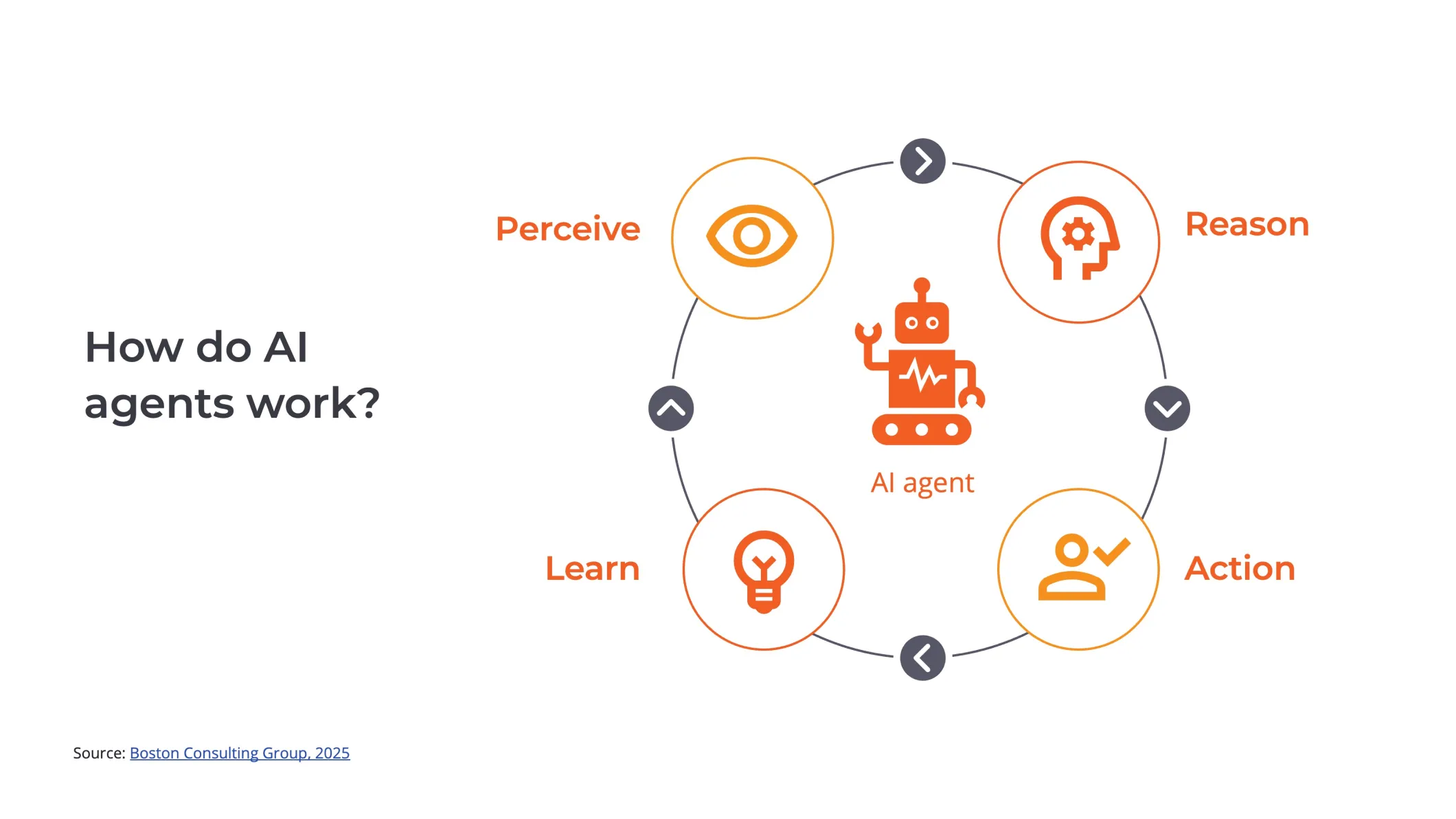
How do AI agents work? At the simplest level, an AI agent perceives its environment, reasons about the best next step, executes that action, and learns from the outcome. It repeats this cycle continuously, with humans validating key decisions at every stage. For UK organisations moving beyond traditional automation, understanding this loop is the first step to decide where AI agents can genuinely help.
This article unpacks what AI agents are and how they differ from the chatbots and rule-based tools most organisations already use. We'll also cover the architecture behind AI agents, the decision logic driving them, and sector-specific use cases.
|
See these principles in action Explore how OneAdvanced applies perception, reasoning and governance to real enterprise workflows across healthcare, legal, education and finance. |
What is an AI agent?
An AI agent is a software system that perceives its environment, reasons about the best action toward a goal, acts across connected systems, and learns from the results – all with human oversight built into each stage.
Unlike a chatbot, which responds to prompts within a single conversation, or RPA, which follows fixed, rule-based scripts, an AI agent weighs options, adapts to new situations, and acts across multiple systems without being told exactly what to do at every step. Organisations must know these differences before the automation they already run.
|
|
Autonomy |
Decision logic |
Learns? |
Integrations |
Best for |
|
AI agent |
High – perceives, plans, acts, learns |
Reasoning engine + ML + rules |
Yes, continuously |
Multiple systems: CRM, ERP, HR |
Complex, multi-step workflows |
|
Chatbot |
Low – responds within a conversation |
Pattern matching / scripted dialogue |
Limited, session-based |
Usually, a single channel |
Customer queries and FAQs |
|
RPA |
Low – executes fixed scripts |
"If this, then that" rules |
No |
Task-specific, brittle to change |
Repetitive, rule-based tasks |
Key components of an AI agent architecture
As AI adoption accelerates across the UK – from 35% of organisations in 2025 to 54% in 2026 – understanding how AI agents work is becoming increasingly important. But first, it’s important to know the key components that enable agents to function.
- Perception: Agents gather information from their surroundings using Natural Language Processing (NLP) to understand text and speech, computer vision to interpret images, and sensors or APIs to process digital and physical inputs.
- Memory: Agents store information from past interactions so they can maintain context, adapt to changing circumstances, and make more informed decisions over time.
- Reasoning: The reasoning engine is the "brain" of the agent. It combines logic, rules and machine learning to analyse situations, weigh options and decide the optimal next action.
- Action: Once a decision is made, actuators carry it out – generating a report, sending an alert, updating a record, or triggering an entire workflow across enterprise systems.
- Learning: Using reinforcement learning, agents assess the outcomes of their actions, identify what leads to success, and gradually adapt to specific workflows and styles.
- Governance: A governance layer of rules, policies and Human-In-The-Loop (HITL) oversight controls agent behaviour, tracks performance, and allows human intervention whenever it's needed.
How do AI agents work? The 4-stage loop
AI agents operate in a continuous loop of perceiving, planning, acting, and learning. Here’s how they work through each stage, and where human input matters most:
Step 1: Perceive
At this stage, the agent acts as an active observer. It gathers data from its environment through sensors, APIs, or digital inputs. As the raw data is messy, incomplete, and noisy, the agent cleans it up, removes inconsistencies, and extracts patterns that matter. This helps the agent understand: What’s happening right now?”
Human role: validate whether the extracted insights truly make sense in the real-world context.
Step 2: Plan
With a clear picture of its surroundings, the agent moves into the planning phase. This is its reasoning mode, where it asks: “given my goal, what’s the best move?” The agent weighs different possibilities, simulates outcomes, and makes choices that maximise success.
Human role: define what “success” means and ensure the chosen strategies align with broader business objectives.
Step 3: Act
This is where ideas become actions. The agent executes the plan by interacting with enterprise systems, databases or other agents. It might log a complaint in a CRM, trigger an update in an HR system, or ask the user for clarification before proceeding.
Human role: monitor how actions impact the real-world outcomes, such as workflows, team efficiency, and customer satisfaction.
Step 4: Learn
An intelligent AI agent shouldn’t stop at action. After each action is taken, the agent measures results, feeds those insights back into its perception phase, and creates a loop of continuous improvement.
Human role: ensure outcomes meet compliance or ethical guidelines and decide how the agent should adjust going forward.
Types of AI agents
Not all AI agents work the same way. Understanding the different types of AI agents helps you match the right approach to the right workflow:
1. Simple reflex agents
Agents that act solely based on current inputs, without considering past or future consequences. They respond to specific conditions using pre-defined rules.
2. Model-based agents
Agents that maintain an internal model of their environment (for example, your business workflow), using past states (memory) to inform their current decisions.
3. Goal-based agents
Agents that achieve specific objectives by strategically planning and executing actions that move them closer to their desired goals. This is where LLM-powered chain-of-thought reasoning becomes central.
4. Utility-based agents
Agents that maximise value by evaluating multiple criteria and selecting the best course of action based on predefined conditions like time, efficiency, or cost.
5. Learning agents
Agents that improve their performance over time by learning from interactions with their environment and historical data. They adapt their behaviour based on outcomes to become more accurate, efficient, and contextually relevant with use.
Each type of AI agent serves a different purpose. They differ in how they make decisions, use memory and learn over time. The table below summarises their key characteristics.
|
Type |
Decision Method |
Memory? |
Learns? |
Best For |
Enterprise Example |
|
Simple Reflex |
Fixed condition-action rules |
No |
No |
Predictable, narrow tasks |
Alerting on a late clock-in |
|
Model-Based Reflex |
Rules + internal model of environment |
Limited |
No |
Semi-predictable environments |
Stock-level monitoring |
|
Goal-Based |
Plans routes to a defined goal |
Yes |
Limited |
Multi-step processes |
Onboarding workflow coordination |
|
Utility-Based |
Weighs outcomes by a utility score |
Yes |
Limited |
Trade-off heavy decisions |
Resource or scheduling optimisation |
|
Learning Agent |
ML and reinforcement learning |
Yes |
Yes, continuously |
Evolving, data-rich environments |
Clinical Summarisation Agent |
The logic behind AI agent decision-making
AI agents are logical thinkers, constantly reasoning and making decisions behind the scenes. Their “intelligence” comes from below explained smart frameworks that empower them to act and adapt to new situations.
Rule-based logic
This is a set of well-defined instructions: “if this happens, then do that.” For instance, if an employee clocks in late three times, an AI tool sends an alert. It’s straightforward, reliable, and perfect for scenarios with clear rules.
Learning-based reasoning
Many AI agents also learn from data. They rely on machine learning and deep learning models to identify patterns, extract insights, and make decisions. A feedback agent, for example, gets better at answering questions by analysing previous conversations, identifying patterns, and extracting insights.
Reinforcement learning is another method in this category that allows AI agents to learn from trial and error, earning rewards for good decisions and penalties for mistakes.
Hybrid models
Hybrid models combine rule-based guardrails with learning power. In fraud detection, for instance, rule-based logic enforces regulatory guidelines while machine learning analyses data to identify anomalies and predict risk. Most UK enterprise deployments favour a hybrid approach: rules keep decisions auditable and compliant, while learning keeps the agent adaptive.
A quick decision guide
- Use rule-based logic when the workflow is stable, regulated, and the correct action is always the same.
- Use learning-based reasoning when the environment changes often and patterns matter more than fixed rules.
- Use a hybrid model when you need both adaptability and a predictable, auditable guardrail — the most common choice for regulated UK sectors.
Multi-agent systems: How AI agents collaborate and scale
A single AI agent can automate individual tasks, but complex business processes often require multiple agents working together. This is where multi-agent systems (MAS) deliver the greatest value.
Multi-agent coordination
In a multi-agent system, each agent is responsible for a specific task while working towards a shared objective.
Take an HR onboarding process as an example:
- An HR Coordinator Agent collects candidate documents and verifies compliance.
- A Payroll Agent sets up salary, tax and benefits.
- An IT Setup Agent provisions devices, accounts and software access.
- A Training Agent schedules induction sessions and assigns learning resources.
Together, these agents automate the onboarding journey while ensuring every step happens in the right order.
Workflow orchestration using AI agents
When linked together, agents can orchestrate end-to-end workflows across entire departments. In retail order fulfilment, for example:
- A Sales Agent processes customer orders.
- An Inventory Agent checks availability and reserves stock.
- A Warehouse Agent instructs robots to pick and pack items.
- A Logistics Agent arranges delivery and keeps customers updated with tracking details.
This seamless handoff between agents mirrors how human teams collaborate, but with machine-driven speed and consistency, enabling organisations to move toward intelligent, fully autonomous workflows.
Real-world AI agent use cases by sector
AI agents are transforming sectors from healthcare and legal to education and retail. OneAdvanced's AI Agent Marketplace brings sector-specific agents to UK organisations, each built with HITL governance by design.
Healthcare
- Clinical Summarisation Agent converts complex medical records into clear, actionable summaries, freeing GPs to spend more time on direct patient care instead of paperwork.
- Clinical Coding Agent supports GPs with diagnosis-based coding, reducing coding errors and speeding up NHS administrative accuracy.
Legal
- Matter Quality Agent gives live insight into quality and compliance across live matters, uncovering risks and priority areas before they escalate. The actionable insights this agent surfaces empower firms to drive strategic decisions, strengthen governance, and deliver consistently excellent client service.
- File Quality Review Agent ensures compliance, reduces risk, and speeds up document review — helping firms deliver client work faster without compromising quality.
Education
- Assessment and Learning AI tool personalises course content and recommends learning paths based on individual student needs.
- Online Tutor Agent provides real-time, on-demand assistance and support outside the classroom.
Retail and Operations
- Inventory Management Agent monitors shelf inventory in real time, reducing excess stock and storage costs.
- Smart Recommendation Agent analyses purchase history and behaviour to personalise offers.
Finance
- Fraud Detection Agents, Automated Invoice Processing Agent, and Compliance Automation Agents reduce manual review time and financial risk across back-office finance functions.
AI agents and UK enterprises: Adoption, challenges & governance
AI adoption across the UK is accelerating at an unprecedented pace. Research from the British Chambers of Commerce and the University of Essex shows that 54% of UK firms are actively using AI in 2026, up from 35% in 2025 and 25% in 2024. At the same time, Gartner predicts that by the end of 2026, 40% of enterprise applications will embed task-specific AI agents, compared with less than 5% in 2025 —highlighting how quickly AI is becoming part of everyday business operations.
Despite this momentum, many organisations are struggling to move from isolated AI pilots to enterprise-wide deployment. A key challenge is skills. OneAdvanced's Annual Trends Report found that skills shortages are the second-biggest operational challenge facing UK organisations, behind only economic uncertainty. Despite recognising the problem, organisations rank talent development last on their investment priority list, creating a growing gap between AI ambition and execution.
Technology is also holding organisations back. The same report found that 58% of organisations are facing a platform integration crisis, while 55% remain stuck in "automation purgatory" — started their automation journey without achieving enterprise-wide deployment. Only one-third (33%) say their technology fully supports strategic goals, and 62% report growing gaps between their existing systems and business ambitions. Bridging this divide requires more than deploying AI agents. Organisations need the right skills, integrated technology and governance to scale AI confidently and deliver measurable business value.
|
Want the full picture behind these numbers? Get the complete data on AI adoption, workforce readiness, integration and ROI from 3600+ UK respondents in OneAdvanced Annual Trends Report 2026 |
Governance: Why HITL and compliance matter
Scaling AI successfully requires more than advanced technology. It demands clear accountability, human oversight and robust controls from day one. Retrofitting governance after deployment increases risk, makes compliance harder and can undermine trust in AI outcomes.
That's why every OneAdvanced AI agent is designed with Human-in-the-Loop (HITL) governance at its core. Built on the OneAdvanced IQ platform, AI agents combine intelligent automation with audit trails, human approval at key decision points and alignment with UK ICO guidance and the UK Government's AI regulatory principles. This connected, trusted and intelligent approach gives organisations the confidence to deploy AI responsibly across regulated sectors such as healthcare, legal, education and the public sector.
How to get started with AI agents in your organisation
Here are five practical steps that can help you to get started with AI agents in your organisation:
Step 1: Identify high-value, repeatable workflow targets
Start by looking at processes that happen often, follow a clear pattern, and are easy to measure – think invoice processing, document review, or onboarding checklists. These are the workflows where an AI agent can prove its worth quickly, without the complexity of a fully bespoke build.
Step 2: Assess data quality and system integration readiness
An AI agent is only as good as the data and systems it connects to. Before rolling one out, check that your ERP, CRM or HR platforms contain clean, accessible data and can integrate with an agent, otherwise you risk automating around a problem rather than solving it.
Step 3: Choose between an off-the-shelf agent vs custom build
Sector-specific agents from a marketplace, such as those built for healthcare, legal or education, get you live faster and come pre-configured with relevant compliance and governance. A custom build makes more sense when your workflow is genuinely unique to your business.
Step 4: Prioritise governance and human oversight from day one
Build Human-In-The-Loop checkpoints and audit trails into the process before you scale, not after. For UK organisations working under ICO and DSIT guidance, this isn't a compliance afterthought; it's what keeps an agent's decisions accountable and trustworthy from the outset.
Step 5: Start with a pilot, measure ROI, then scale across the business
Prove value in one workflow first, track hours saved, error rates and cost reduction, before expanding into multi-agent orchestration. A well-measured pilot also builds the internal confidence needed to secure buy-in for wider rollout.
Conclusion
AI agents aren't just transforming how work gets done; they're reshaping what's possible across every corner of enterprise. To recap:
- AI agents perceive, plan, act and learn in a continuous loop, with human oversight built into every stage.
- Multi-agent systems let organisations orchestrate entire workflows across departments, not just single tasks.
- AI adoption in the UK is accelerating (54% of firms are already using AI) but skills gaps and integration complexity remain real barriers.
- Governance and Human-In-The-Loop oversight are what make agentic AI usable in regulated UK sectors like healthcare, legal and education.
So, whether your challenge is streamlining HR, healthcare, retail or legal operations, there's an AI agent built to optimise your workflow.
|
Ready to see agentic AI in your workflows? Explore sector-specific agents across healthcare, legal, education and finance in the OneAdvanced AI Agent Marketplace. |
Frequently Asked Questions (FAQs)
What is the difference between agentic AI and traditional automation or RPA?
RPA follows fixed, rule-based scripts and breaks when a process changes. Agentic AI reasons about the best action, adapts to new situations, and can coordinate across multiple systems without being told each exact step.
How do AI agents make decisions autonomously?
Agents combine rule-based logic, machine learning and, in hybrid models, both – weighing options against a goal and choosing the action most likely to succeed, within governance boundaries set by humans.
What is a multi-agent system and how do AI agents collaborate?
A multi-agent system is a group of specialised agents, each with a defined role, that share information and hand off tasks to complete complex, cross-department workflows — such as HR onboarding or retail order fulfilment.
What is Human-In-The-Loop (HITL) and why does it matter for governance?
HITL means a human validates, guides or intervenes in an agent's decisions at key stages. It matters because it keeps agentic AI accountable, auditable and compliant — essential for regulated UK sectors.
Can AI agents integrate with existing ERP, CRM and HR systems?
Yes. Enterprise AI agents are designed to plug into existing platforms, triggering updates in a CRM, HR system or ERP rather than replacing them.
How do you measure the ROI of an AI agent deployment?
Start with a single pilot workflow and track hours saved, error reduction, faster completion times and labour cost savings before scaling.
How are AI agents used in UK healthcare organisations?
They convert medical records into actionable summaries and support diagnosis-based coding, reducing admin time so GPs can focus on patient care.
Can AI agents help law firms automate document review and compliance monitoring?
Yes. Agents can flag matter-level risks and compliance gaps before they escalate and speed up compliance-ready document review and processing.
What AI agents does OneAdvanced offer for UK enterprises?
OneAdvanced's AI Agent Marketplace offers sector-specific agents including the Clinical Summarisation Agent, Clinical Coding Agent, File Quality Review Agent and Assessment and Learning AI tool — each built with Human-in-the-Loop (HITL) governance and designed to integrate with your existing systems.
About the author
OneAdvanced PR
Press Team
Our dedicated press team is committed to delivering thought leadership, insightful market analysis, and timely updates to keep you informed. We uncover trends, share expert perspectives, and provide in-depth commentary on the latest developments for the sectors that we serve. Whether it’s breaking news, comprehensive reports, or forward-thinking strategies, our goal is to provide valuable insights that inform, inspire, and help you stay ahead in a rapidly evolving landscape.
Contact our sales and support teams. We're here to help.
Speak to our expert consultants for personalised advice and recommendations or to book a demo.
Call us on
0330 343 4000Please enter your details, and our team will contact you shortly.
All fields are required
From simple case logging through to live chat, find the solution you need, faster.
Support centre