
Simon Walsh on the challenges and opportunities of AI integration in healthcare
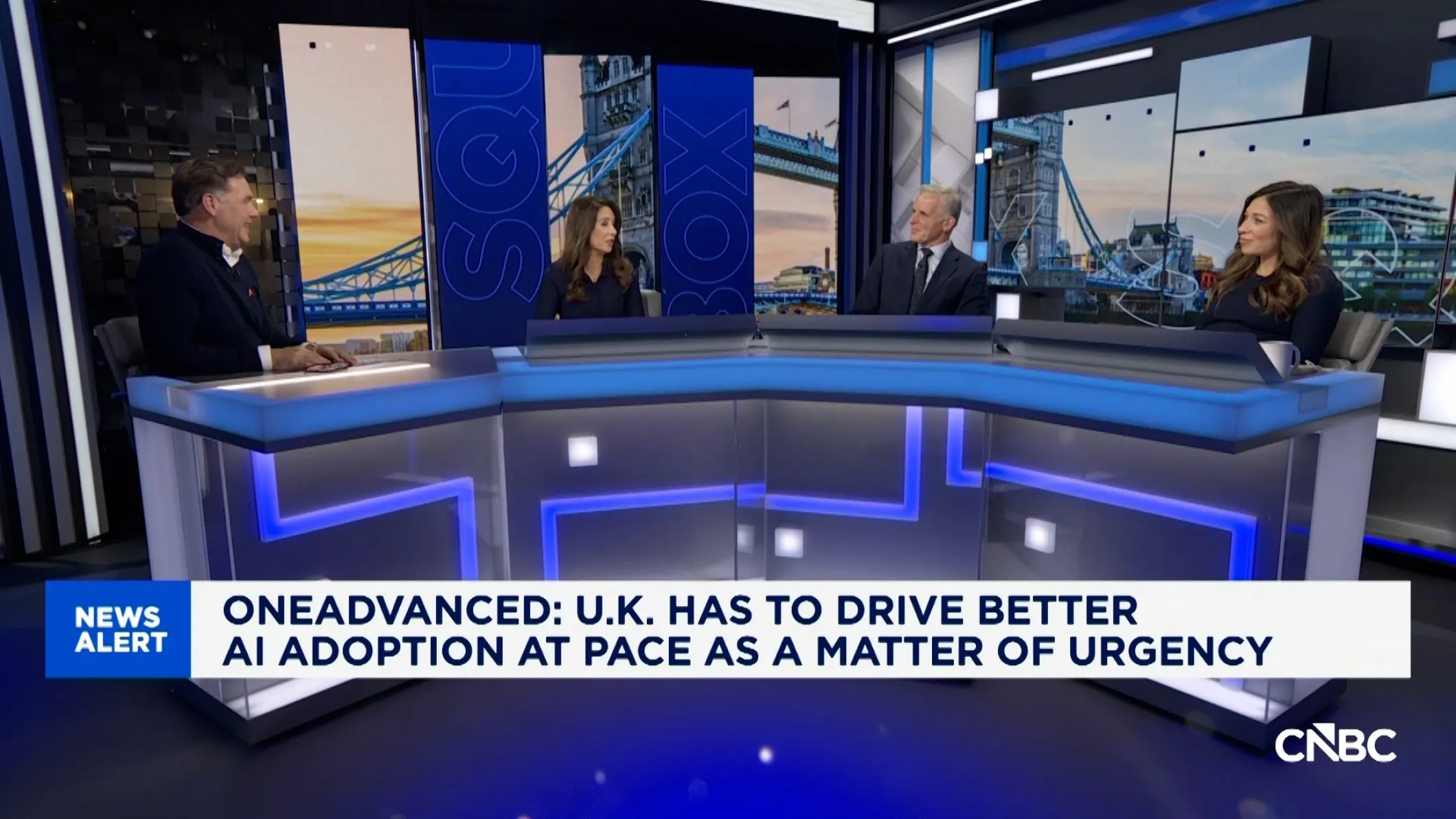
OneAdvanced’s CEO, Simon Walsh, joined CNBC's Steve Sedgwick, Karen Tso and Julianna Tatelbaum on 15th January 2026 to discuss our 10th Annual Trends Report, and the critical importance of AI integration in healthcare.
by Health and CarePublished on 23 January 2026 5 minute read
We’ve followed the business insights of senior leaders across the UK for a decade, bringing light to the challenges they’ve faced from cyber-crime, to remote working, to digital skills gaps. This year, these factors rear their heads once again but with a common theme: AI.
Digital transformation challenges remain a central factor for organisations across the board, with 34% of healthcare respondents saying they’re now facing internal execution issues such as slow AI adoption, poor integration, and manual workflows.
Simon Walsh explores this sector wide issue in more detail during the CNBC discussion; “What they said circa ten years ago was that they expected to have completed their digital transformation by 2026. And yet, really, what they're all learning is that there's no start, middle and end to digital transformation. It's actually just this constant amount of change. And AI is now adding to that level of requirements to adapt and adopt. And the big thing is really data. Where is your data? Who's got sovereignty over your data, and how do you leverage your data in the flow of work.”
The push for AI integration in healthcare
While the report pulls from many different sectors, one clear standout was healthcare. Healthcare organisations are investing heavily in digital technologies, but they're struggling to do what's needed to integrate them. During the discussion, questions arose around how GPs and the wider NHS lack a combined system, and what could be causing this issue.
Simon explains “Firstly, the NHS, primary care, secondary care: you've got disparate systems. There's a number of regulations and standards that the NHS implement. But if you see what the Rt Hon Wes Streeting is really proposing with the new NHS digital plan, it's really to create, and there's three components of that: from central care to community care e.g. hospital to community, from analogue to digital, and then from sickness to prevention. But how do you go from sickness to prevention? Data. You've got to leverage the data.”
“The analogue to digital is a move to really share data across. But, if you think about primary care, which is where our personal health record is stored, that is accessible by secondary care if you have an outpatient appointment, and part of the solutions that we provide enables summarisation and AI capability on that healthcare record for the GP.”
“One of the policies of the government is to put what they call online consultations, because there's this 8 a.m. scramble to get an appointment… And a piece of technology that we've deployed to the GP practices - we serve about 75% of English GP's and 100% of Scotland and Ireland - is to enable them to do a digital consultation, filling in a form, and it will start to do triage.”
But of course, the NHS has discussed digitalisation for years. Simon was asked for his opinion on the most recent policies outlined in the NHS 10 year plan: “I absolutely think the policies that they're trying to implement are the right things to do. If you think about it from sickness to prevention, you cannot fault that as a strategic agenda of the government. That is a necessity. Ultimately, there's no way the country can continue to support the level of sickness that the country endures… The challenge is decades of underinvestment and not just underinvestment in the clinical teams, but underinvestment in the operating environment.”
“And so, what we've all got to do is lean into that subject. We've spent a significant amount of capital invested in the UK to really advance the solutions we provide to the health system. So, I'm confident their strategy is right. It's going to take quite a significant sea change, but you've got to do it in pieces. And I think the front door, primary care, which is where the patients first touch, is the thing we should be modernising the fastest.”
The discussion goes on to explore how investment in AI is accelerating but workforce readiness is lagging behind, being a key bottleneck when it comes to AI integration in healthcare.
“If you think about a clinician in a GP practice, they're not really a technician for it. That's not their job and shouldn't be. Companies like ours and the rest of the market has an obligation to make it easier for the customer to consume. The challenge is not so much the clinician’s ability to use technology, it's the fact that there's so many disparate systems, lots of legacy. We call it technical debt, and getting those integrated, collaborating, and working to make the work seamless, is actually really the problem. Because if you have to log in to 12 systems to do your job, that is a technical nightmare.”
To explore the report’s findings for yourself, visit: www.oneadvanced.com/trends-report/
About the author
Health and Care
Press Team
We create content to empower professionals across health and social care, from care-facing teams to leaders. Our insightful articles bring light to the sectors’ unique needs, from clinical and care management, to finance, risk management, and people management. Leveraging deep expertise in health and social care, we provide clear, actionable insights to simplify processes, drive growth, and support these critical pillars of our communities for the future. Our goal is to help free up more time for what truly matters—delivering exceptional care to patients and clients.
Contact our sales and support teams. We're here to help.
Speak to our expert consultants for personalised advice and recommendations or to book a demo.
Call us on
0330 343 4000Please enter your details, and our team will contact you shortly.
All fields are required
From simple case logging through to live chat, find the solution you need, faster.
Support centre